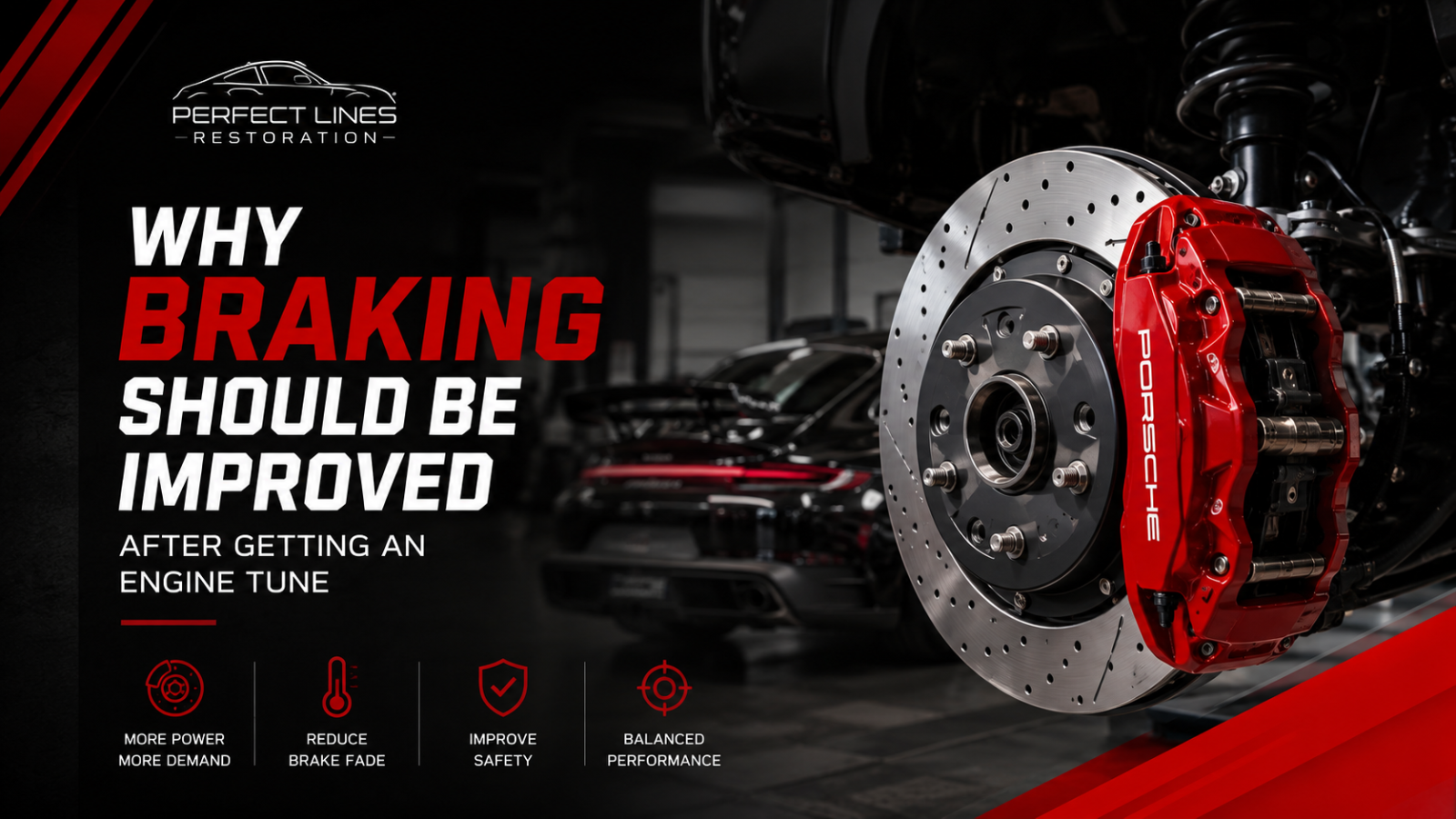
Engine tuning is one of the most popular ways to unlock additional performance from a vehicle. Whether through ECU calibration, performance modifications, or a custom build, tuning can significantly increase horsepower and torque, making the driving experience more exciting and responsive.
However, while many drivers focus on making their vehicle faster, they often overlook an equally important component: the braking system.
At Perfect Lines Restoration, performance is about more than just power. A truly refined vehicle must accelerate, handle, and stop with equal confidence. That is why improving braking performance should always be considered after increasing engine output.
The Relationship Between Engine Tuning and Braking Performance
When an engine produces more power, the vehicle accelerates faster and reaches higher speeds more easily. While this enhanced performance improves driving enjoyment, it also places additional demands on the braking system.
The faster a vehicle travels, the more energy the brakes must manage when slowing it down. As a result, components that performed well under factory specifications may struggle when faced with increased performance levels.
| Vehicle Setup | Braking Demand |
|---|---|
| Factory Specification | Standard braking load |
| Mild Engine Tune | Increased stopping requirements |
| Performance Tune | Higher heat and braking stress |
| Track Focused Build | Maximum braking demand |
Without suitable braking improvements, drivers may experience reduced stopping efficiency and increased wear on braking components.
Why Factory Brakes May No Longer Be Enough
Vehicle manufacturers design braking systems to suit everyday driving conditions. These systems are typically intended for commuting, highway driving, and occasional emergency stops.
After tuning, the demands placed on the brakes often exceed what the original system was designed to handle.
Increased Brake Fade
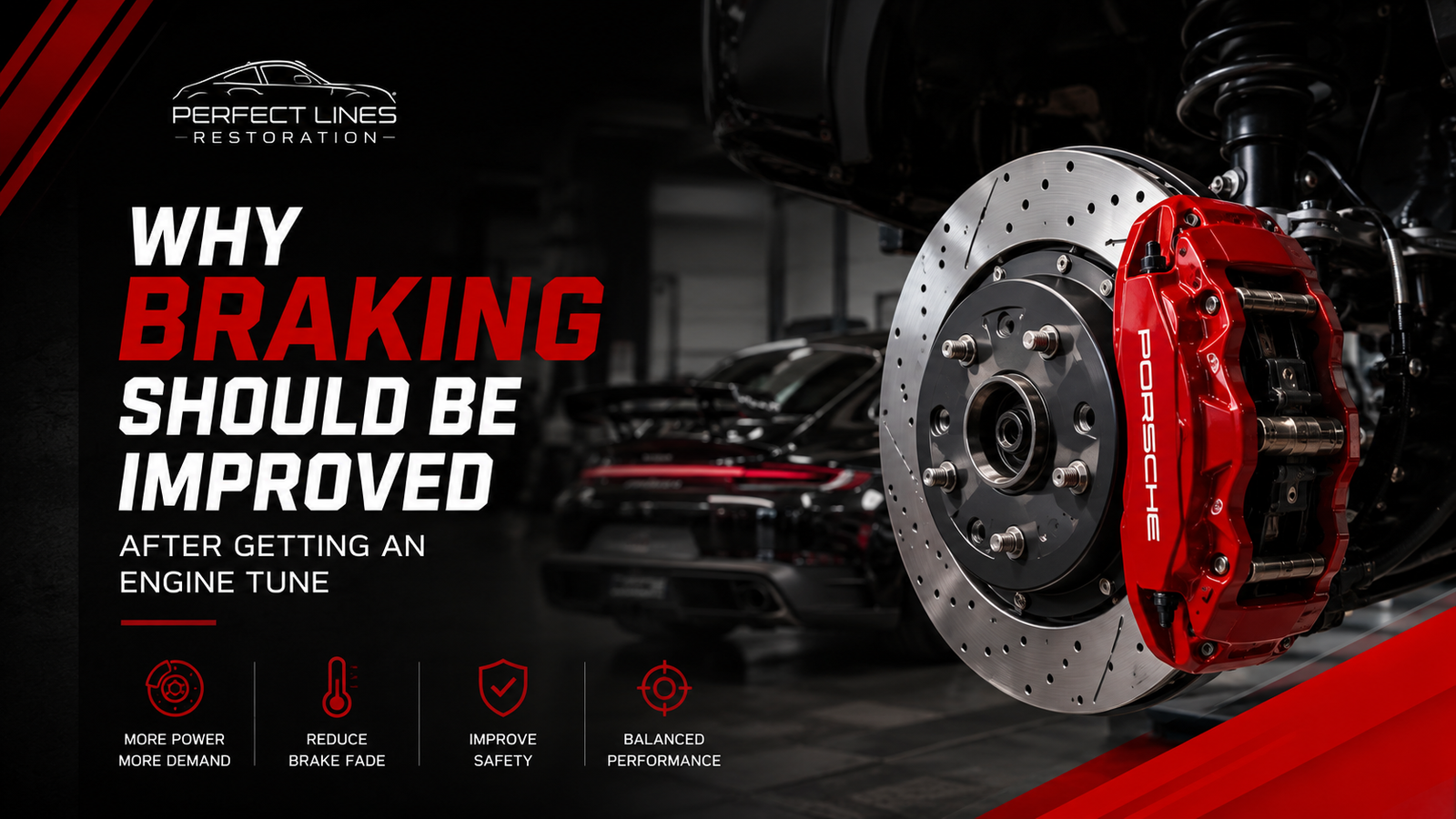
Brake fade occurs when excessive heat builds up during repeated or aggressive braking. As temperatures rise, braking performance can decrease, leading to longer stopping distances and reduced driver confidence.
This is especially common in tuned vehicles that are driven enthusiastically.
Longer Stopping Distances
Additional horsepower often means higher speeds and greater momentum. Even if acceleration improves dramatically, braking performance may remain unchanged, creating an imbalance that can affect vehicle safety.
Reduced Driver Confidence
A vehicle that accelerates quickly but struggles to stop effectively can feel unpredictable. Balanced performance requires both strong acceleration and dependable braking capability.
Key Brake Improvements to Consider
Performance Brake Pads
- Better stopping power
- Improved heat resistance
- Enhanced pedal feel
- Greater fade resistance
For many road driven performance vehicles, upgraded pads provide a noticeable improvement without major modifications.
Upgraded Brake Rotors
Performance rotors are designed to manage heat more efficiently than standard components.
Popular options include:
- Slotted rotors
- Drilled rotors
- High performance vented rotors
These upgrades help maintain consistent braking performance under demanding conditions.
Stainless Steel Brake Lines
Brake lines are often overlooked, yet they contribute significantly to pedal response.
Stainless steel braided lines reduce expansion under pressure, resulting in:
- Firmer pedal feel
- Improved responsiveness
- More consistent braking performance
Big Brake Kits
For high horsepower vehicles and track oriented builds, a larger braking system may be necessary.
A typical big brake kit includes:
- Larger rotors
- Multi piston calipers
- Improved cooling capacity
- Increased braking force
These systems provide superior stopping performance and improved durability during aggressive driving.
The Importance of a Balanced Performance Build
Many enthusiasts focus exclusively on horsepower gains. However, true performance comes from balance.
A properly developed vehicle should have harmony between:
Engine Performance
The power needed for strong acceleration and responsiveness.
Suspension
The control necessary to keep the vehicle stable during cornering and braking.
Tires
The grip required to transfer power and braking forces to the road.
Braking System
The stopping power needed to safely control increased vehicle performance.
At Perfect Lines Restoration, every vehicle is approached with a complete performance mindset. The goal is not simply to create a faster car, but to create a vehicle that feels refined, predictable, and enjoyable in every driving situation.
When Should You Consider Brake Improvements?
Brake upgrades should be considered if your vehicle has received:
- ECU tuning
- Performance engine modifications
- Turbocharger upgrades
- Custom performance enhancements
- Track day preparation
- High horsepower restoration work
Modern Restoration Techniques
Today’s restoration methods have evolved with technology and innovation. Professionals now use advanced tools and techniques to deliver better and more efficient results.
These advancements allow for:
- More accurate work
- Faster turnaround times
- Higher-quality finishes
- Reduced long-term maintenance
If your vehicle accelerates faster than it did from the factory, it is worth evaluating whether the braking system can match its new capabilities.